
Theatricality, didacticism, prosaic verse, use of persons as symbols, contemplative mood, flashbacks are some of Cavafy’s recurring ‘tropes’. Discuss. By Marc Schmidt
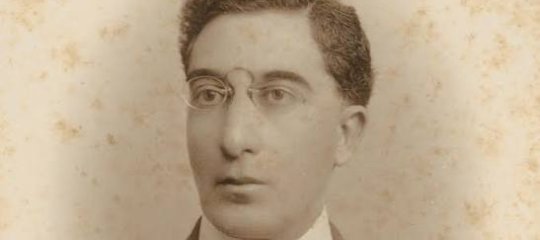
Timelessly enigmatic and multifaceted, the poetry of Cavafy has eluded scholars for generations - his masterful use of innumerable overlapping tropes, his theatrics, symbolism, trademark contemplative mood, unique use of memory and flashbacks, and his didactic touch make for a fascinating reading experience. In attempting to understand the various tropes employed by Cavafy it is incredibly important to understand who he was as a person, the environment that shaped him and the motivation behind his poetic style. While, as Seferis famously said, 'Outside of his poems (...) Cavafy does not exist' (Boletsi, 2006: 397), this does not mean that his personal circumstances can be so simply divorced from his works. Examining Cavafy's poetry reveals a whole world of subtlety, irony, and battles between contradicting forces, paralleling his own life in Alexandria, and this world is united, principally, by certain recurring tropes. Arguably one of the most widely accepted and recognisable tropes present in Cavafy's work would be that of theatricality, with these qualities being noted in his writing from early on in the 20th century onwards, words such as 'dramatic' and 'theatrical' being used to describe his work frequently enough that they quickly became established qualities of his poetry (Pappas, 2019: 1). An inextricable aspect of Cavafy's theatricality would be his use of performativity, certain dramatic acts that manifest themselves with great frequency throughout his work - threats, judgements, orders and other actions expressed by his characters, but none more so than promises - implicit or explicit (Boletsi, 2006: 398). Among the most well-known examples of this can be found in 'Alexandrian Kings' (1912), a dramatised retelling of the Donations of Alexandria in 34 BCE, when Cleopatra's children were given hollow and lofty titles, made rulers, and in some cases promised land not yet conquered - Caesarion most of all, as Cavafy points out: 'Him they named above his younger brothers / him they named King of Kings' , all in vain as only 3 years later Antony would be defeated at Actium. The whole ceremony is a large 'festival', as Cavafy put it, and Cleopatra's children are likened to tragic actors on a stage, with the crowd knowing full well that they are doomed, yet are willing to go along with the celebration for the sake of it, with a willing suspension of disbelief (Boletsi, 2006: 405) and in a sobering display of apathy, as 'the day was warm and poetical, / the sky a pale azure, / the Alexandrian Gymnasium / a triumphant accomplishment of art’ . It is clear that Cavafy understood theatre intimately, and he acts not just as a 'poet-historian', but also as a stage director - his poetry features clear stage directions, set design, sound, lighting and techniques such as the dramatic monologue, owing that influence to Browning and Tennyson, and arguably also being influenced by Naturalism (featuring intricate 'sets' and where every detail and object described has a particular importance), such as in the opening stage directions of 'One Night' and in the multidimensional stage of 'To Stay'. Further, his style as a theatrical poet is often reminiscent of plays with several successive scenes with very little filler (Pappas, 2019: 5), as seen in 'Myris: Alexandria, A.D. 340’, as the young Pagan personage assumed by Cavafy quite rapidly ruminates on his fond adventures with Myris prior to his death, as if he is running out of time . Another defining trope of Cavafy's works would be that of Didacticism. The didactic method, in its most concise possible definition, intends to teach, to explain a rich truth, oftentimes a life lesson. Throughout his career, Cavafy experimented with various modes of poetry - not just the didactic, but also the lyric, narrative and dramatic, and as such it has been quite difficult to effectively categorise his work - Seferis, for example, found himself struggling to decide between the didactic and the dramatic (Keeley, 1983: 157). The 1911 poem 'Ithaka' stands as possibly the most well-known of his works, and certainly possesses one of the most clear examples of the trope. It is heavily inspired by the humanistic mythology of the Odyssey (Dimirouli, 2014: 136), and begins with absolutely wondrous semantics, as 'you set out for Ithaka / hope your road is a long one / full of adventure, full of discovery' , taking a rather metaphysical dimension and a reassuring tone as it notes 'as long as a rare excitement / stirs your spirit and your body (...) you won't encounter them', them being the Laistrygonians, the Cyclops, the 'angry Poseidon', unless 'you bring them along inside your soul / unless your soul sets them up in front of you' . Ithaka, then, offers quite a fascinating insight into the human condition - fear, anxiety, strength of spirit can stop an adventure and opportunity before it has even begun, and perhaps it is not the destination that is so important, as Cavafy points out, but rather the process of getting there, the journey and the wisdom accumulated along the way (Dimirouli, 2014: 136), and 'if you find her poor, Ithaka won't have fooled you / Wise as you will have become / you will have understood by then what these Ithakas mean' . The destination, then, was merely a motivating force (Dimirouli, 2014: 136), and the perceived disappointment upon finally arriving there is merely an inevitability of having completed a worthwhile adventure. It comes as no surprise, then, that this idea reappears in 'Myris: Alexandria A.D. 400', where the unnamed pagan is confronted with a world that is so unlike his, in a poem that ends so abruptly and without any definitive conclusion, as he 'hastened out of their dreadful house'. The identity of Myris is irrelevant; it is the dilemma presented in the journey to the house that dominates, and persists throughout, the self-reflection as a result of being confronted with a foreign, unknown aspect of reality (Dracopoulos, 2003: 142). An aspect of Cavafy's writing that has eluded a generation of scholars would be his use of the prosaic verse. Over more than 25 years, Cavafy wrote several poems with lines broken in the middle (17 in total), many without a conventional rhyme scheme (or one at all, for that matter). 'He Swears' for example, abandons the division in the final two lines completely (Faubion, 2003: 42-3), but how could he be writing poetry if he expressed himself in prose? How could poetry be emotional without emotive language? This 'problem', referred to as such by Nasos Vayenas, is not beyond solution, if Cavafy's use of irony is considered (Keeley, 1983: 157-8). Vayenas sees Cavafy's technique as the 'poetics of irony', a central and even defining feature of his writing, without hidden meanings nor depth, but rather, as Beaton puts it, a 'multiplicity of surfaces' made possible through irony, which cannot be separated from his self-deprecating humour, either (Beaton, 1982: 518). The 1917 poem 'House with Garden' is a particularly good example of this, with the persona of the gardener talking lovingly about having 'no less than seven cats - two jet-black / and two as white as snow, for the contrast / an important parrot (...) / as for dogs, I think three would do me nicely' , a sort of parodic allegory of the world of his own poetry, juxtaposing these inherently contradictory animals, much like the characters and situations in his other more serious poems, his mature ironic voice subtle and complex (Beaton, 1982: 519). This subtle irony that Beaton talks about is paired with an equally subtle contemplative tone, almost sarcastic when looking at 'Aemilianus Monaë' or 'Nero's Term', two poems that both begin triumphantly, Aemilianus with 'an excellent suit of armour I shall fashion / and thus I'll face the wicked / having no fear of weakness' , parading himself around with a certain air of invincibility, and likewise Nero with '(...) beware the age of seventy-three / He still had plenty of time to enjoy himself / He is only thirty / More than ample (...) time' . But both these poems end in a twist of dramatic irony; Aemilianus dies at 27 years old in Sicily, with the poet mockingly remarking: 'I wonder, did he ever fashion that suit of armour?' , and Nero is revealed to be worrying about the wrong 'seventy-three', as it is Galba, the man of seventy-three and his army that is the real threat - both poems ending with the same bittersweet contemplation (disappointment, even) on the part of Cavafy. Memory in the world of Cavafian poetry goes far beyond a simple literary device. It is a living, breathing thing, something that can be appealed to, something that is far more enduring than the simple concept of a past, present and future. In analysing Keeley's idea of the mythical city of Alexandria, Faubian recognises that Cavafy specifically arranges scenarios and personalities from his Alexandria to directly converge or contrast with the Alexandria of the past (Faubion, 2003: 43). Cavafy's use of flashbacks as a trope, likewise, exemplifies this convergence. The story of Myris, and the worlds of Paganism and Christianity parallel the multicultural and cosmopolitan nature of Alexandria in Cavafy's time, especially considering the trans-national and imperial context of the time (Murphy, 2003: 75). The protagonist, in his attempt to understand, rapidly flits through memories of his Myris, the one he knew, saw, heard and touched - yet it all unravels in front of his eyes (Dracopoulos, 2003: 138). In 'Gray', the narrator - mourning his lover of many years past - appeals to (or rather begs of) a personified memory to keep 'those gray eyes / that lovely face' just as he remembered them, even if 'that lovely face will have spoiled' , almost as if memory itself is holding his lover hostage, ending with a final desperate 'whatever of that love you can bring back / (...) bring back tonight' . These pleas suggest that hope endures even after all this time in memory through language, but also present is the fear that language and memory may fail to carry this out (Boletsi, 2006: 403). A final manifestation of memory (similarly in relation to love in crisis) can be found in 'December, 1903', the poem opening with the subject complaining of not being able to express their love, or to talk of their beloved. Memory in this poem takes on a more delicate quality, as these frustrations are turned defiantly inward as 'your face that I keep within my heart / the sound of your voice that I keep in my mind / (...) rising in my dreams / give shape and colour to my words' , thus taking the external and protecting love through the guardian that Cavafy makes of memory (Nehamas, 1983: 310). Eroticism as a trope is one of the most recurring and inextricable elements of Cavafy's poetry, yet it remains one of the most misunderstood and undervalued. Several biographical and psychological misconceptions arose in the past due to Cavafy's sexuality, analysing his poetry as if cracking a code and gaining an insight into the poet's private life, but these have since been discredited as disingenuous speculation (Alexiou, 1983: 47), and the assumption that Cavafy must mean something 'deeper' has served only to reduce the value of his work (Beaton, 1982: 517). In analysing Cavafy's use of Eroticism, Peter A. Bien perceived what he termed the 'underlying unity' between erotic, historical and poetic themes present in Cavafy's work (Alexiou, 1983: 46-47), and there is perhaps no better example of this than that of 'Caesarion'. This poem has long held the status of being the 'key' to Cavafy's works, and in it the historical and poetic clearly collide in the use of words such as 'Πολυκαισαρίη' (too many Caesars), an adaptation from the ancient Greek apparently told to Octavian himself. Furthermore, 'Caesarion' as a whole offers a subversive image of what is expected from a king, and fashions him into an ideal victim, the very image of the fleeting youth that manifests so frequently in Cavafy's poetry. He appears in the dark, 'pale and weary, as [he] would've been / in vanquished Alexandria, ideally beautiful in [his] sorrow / still hoping they would show [him] mercy' , and stands in stark contrast to the 'Berenices and Cleopatras' - but this is hardly a new interpretation of his character. The 'beautiful but passive victim (...) with a decadent melancholic and almost metaphysical sadness’, as Kayalis puts it, was actually not that unknown of a persona in Cavafy's time, and this consistent characterisation could be directly attributed to his relation to the legend of Cleopatra (Kayalis, 2019: 61). In other works, most of all in 'Melancholy of Jason, son of Kleander', we yet again see this theme of fleeting youth, as Jason laments 'the aging of my body and of my face / it's a wound from an atrocious knife / I can endure it no more' , demonstrating a real unity of the themes and tropes that define Cavafy's poetry. A lesser-known trope would be that of the duality between perception (or perhaps rhetoric), and reality. In Cavafy's poems, perhaps owing to their intrinsically theatrical nature, characters often operate as actors within their own world, wearing a mask as they navigate the theatre that is their everyday lives. Revisiting 'Alexandrian Kings', we can find a most topical and clear example of this, not just in the physical separation between the stage and the crowd, but also in how the lines between rhetoric and reality are eventually blurred - and thus the entire first part of the poem being effectively cancelled - when juxtaposing the grandeur of the moment with the quiet knowledge of the crowd that it is all a show (Boletsi, 2006: 405). In this scene Caesarion, whom 'they named King of Kings' , stands out particularly as one of the more prominent actors, and his character is in turn made into a symbol by Cavafy (another common trope), one of an innocence martyred and exploited for the purpose of political rhetoric and theatre, thus granting legitimacy to those truly in power, his mother Cleopatra and Mark Antony. The crowd knows this, the audience knows this, yet they have no choice but to watch. Another way in which perception and reality collide in Cavafy's poetry would be in the case of Myris, and the crisis of identity that occurs throughout the poem, which has already been touched upon but takes on a more complex dimension when considering not just the perspective of his relatives, but also that of Myris himself; the poem constructs a natural sympathy for the protagonist, with his reality being the one we are most exposed to, but the shock that is experienced when 'the dead man's relatives kept looking at [him] / with obvious perplexity and displeasure' suggests that the relatives, themselves, saw their own perception of reality crumble at being confronted with the young pagan, and as a whole the fabric of accepted reality crumbles for both sides. Cavafy's playing with the elusive 'essence' of Myris is simply that - the poem does not seek to answer what the true reality is, what Myris himself, the now-dead man had to say about his contradictory identities, whether they were complimentary, symbiotic or contradictory to him (Dracopoulos, 2003: 137), but rather functions to show how nothing is as it seems, and how reality is not a concrete concept, but rather completely in the eyes of the beholder. A final and significant trope present in Cavafy's work would be that of the fascinating and (oftentimes) contradictory unknown. According to Beaton, the real emotional impact of Cavafy's poetics derives not from the sensuousness of the language, nor the intensity of any vision, but rather from the vivid juxtaposition of contradictory emotions, angles and visions. This is present not only in 'House with a Garden' (the parodic poem mentioned before), but also in 'Dangerous Thoughts', as it begins with a certain historical distance and introduces the character of Myrtias as 'in part a heathen, in part christianized' , his talk of theory and study colliding with his passion and dreams of the erotic, his self-confidence contrasting with the way of the world. In this way, he plays with 'dangerous things' in ignorance of the real danger - his own self-deception in his belief that he can regain his spirit 'as it was before (...) ascetic' . It is precisely this contradiction between the practical and the theoretical, of character, confidence and self-deception that is so fascinating to Cavafy (Beaton, 1982: 520). The case of Caesarion, likewise, is one of the fascinating unknown. The fact that Caesarion is so hidden, so lost to history is what ultimately makes his story so worthwhile - the lack of sources on his life allow for the poet-historian to shape a new Caesarion, one unburdened by the shackles of historical accuracy, one that emerges from the shadows, one that can be made 'beautiful and sentimental', his art bestowing 'upon [his] face / a dreamlike, genial grace' . Caesarion is a powerful homoerotic symbol that conveys purity, innocence and dignity that stands in stark contrast to the 'vulgar sexuality (...) and conniving traits' typically (and misogynistically) attributed to the heteronormative idol of the time, his mother Cleopatra (Kayalis, 2019: 64). It is Caesarion's independence of the 'Berenices and Cleopatras' and his elusive role in history that makes him all the more fitting and fascinating in the context of Cavafian poetry. Overall, Cavafy's poetic style demonstrates a remarkable underlying unity of tropes, not only between the theatrical, didactic, prosaic, symbolic and contemplative, but also between the poetic, historic and erotic (Alexiou, 1983: 46-47), a unity that permeates throughout. The use of eroticism to ruminate on his lifelong preoccupation with the idea of fleeting youth goes hand in hand with his experimentation with flashbacks, developing the idea of a memory that is more than just an abstract concept, but a living, breathing, accountable (Boletsi, 2006: 403) and inextricable part of his world. Contradictions and irony above all give Cavafy his strength - the juxtaposition of two contrasting perspectives and realities, the unknown and the forgotten against the remarkable and revered fascinated Cavafy. The idea of the unknown, especially in the case of Caesarion, constituted a tabula rasa from which to craft a new poetic vision, and the blurring (or complete collapse) of the lines between rhetorical perception and reality (Dracopoulos, 2003: 143) - such as in Alexandrian Kings and the story of Myris - features frequently in his works. His is a subtle and complex poetry, one deeply ironic and sometimes self-deprecating (Beaton, 1982: 518), and his outstanding use of tropes solidifies the relevance of his works and his reputation as one of the most impactful Greek poets of the 19th and 20th centuries. Reference List Primary Sources Translated by Sachperoglou, E. - Cavafy, C.P. (2008) ‘Alexandrian Kings’, translated by Sachperoglou, E. in C.P. Cavafy: The Collected Poems, 53-55. Oxford. - Cavafy, C.P. (2008) ‘One Night’, translated by Sachperoglou, E. in C.P. Cavafy: The Collected Poems, 71-73. Oxford. - Cavafy, C.P. (2008) ‘Myres: Alexandria, A.D. 340’, translated by Sachperoglou, E. in C.P. Cavafy: The Collected Poems, 187-191. Oxford. - Cavafy, C.P (2008) ‘Aemilianus Monaë, Alexandrian, A.D. 628-655’, translated by Sachperoglou, E. in C.P. Cavafy: The Collected Poems, 97. Oxford. - Cavafy, C.P (2008) ‘Nero’s Term’, translated by Sachperoglou, E. in C.P. Cavafy: The Collected Poems, 87. Oxford. - Cavafy, C.P (2008) ‘Caesarion’, translated by Sachperoglou, E. in C.P. Cavafy: The Collected Poems, 85-87. Oxford. - Cavafy, C.P (2008) ‘Melancholy of Jason, Son of Kleander, Poet in Commagene, A.D. 595’, translated by Sachperoglou, E. in C.P. Cavafy: The Collected Poems, 131. Oxford. Translated by Beaton, R. - Cavafy, C.P. (1982) ‘House with Garden’, translated by Beaton, R. in C.P. Cavafy: irony and Hellenism, London. Translated by Keeley, E. and Sherrard, P. - Cavafy, C.P. (1975) ‘Ithaka’, translated by Keeley, E. and Sherrard, P. in C.P. Cavafy: Collected Poems Revised Edition. Princeton. - Cavafy, C.P. (1992) ‘Gray', translated by Keeley, E. and Sherrard, P. in C.P. Cavafy: Collected Poems Revised Edition. Princeton. - Cavafy, C.P. (1992) ‘December 1903', translated by Keeley, E. and Sherrard, P. in C.P. Cavafy: Collected Poems Revised Edition. Princeton. - Cavafy, C.P. (1992) ‘Dangerous Thoughts', translated by Keeley, E. and Sherrard, P. in C.P. Cavafy: Collected Poems Revised Edition. Princeton. Secondary Sources - Alexiou, M. (1983) ‘Eroticism and poetry’, in ‘C.P. Cavafy’, Journal of the Hellenic Diaspora 10, 45-65. - Beaton, R. (1982) ‘C.P. Cavafy: irony and Hellenism’, Slavonic and East European Review 59/4, 516-528. - Boletsi, M. (2006) ‘How to Do Things with Poems; Performativity in the Poetry of C.P. Cavafy’ Arcadia 41, 396-418. - Dracopoulos, A. (2003) ‘Reality Otherness Perception: Reading Cavafy’s Myris: Alexandria, A.D. 340’ Pages on C.P. Cavafy, in Modern Greek Studies (Australia & New Zealand) 11, 134-145. - Dimirouli, F. (2014) Cavafy Hero: Literary Appropriations and Cultural Projections of the Poet in English and American Literature. Oxford. - Faubion, J.D. (2003) ‘Cavafy: Towards the Principles of a Transcultural Sociology of Minor Literature’ Pages on C.P. Cavafy, in Modern Greek Studies (Australia & New Zealand) 11, 40-65. - Kayalis, T. (2019) “Cavafy’s Historical Poetics in Context: ‘Caesarion’ as Palimpsest’, JMH 34, 43-69. - Keeley, E. (1983) ‘Voice, perspective and context’ in Cavafy, Modern Greek Poetry, Voice and Myth, 3-30. Princeton, New Jersey. - Murphy, P. (2003) ‘The City of Ideas: Cavafy as a Philosopher of History’, Modern Greek Studies (Australia & New Zealand) 11-12, 75-102. - Nehamas, A. (1983) ‘Memory, pleasure and poetry: the grammar of the self in the writing of Cavafy.’ JMGS 1, 259-319. - Pappas, A. (2019) Performance and theatricality in the poetry of C.P. Cavafy. Trinity. One of the best essays written on Cavafy by a Modern Greek literature student taught by Dr Dimitra Tzanidaki

- Εισέλθετε στο σύστημα για να υποβάλετε σχόλια
Είσοδος
Ετικέτες άρθρων
Αρχείο άρθρων
- Φεβρουάριος 2026 (1)
- Μάρτιος 2025 (2)
- Φεβρουάριος 2024 (4)
- Ιανουάριος 2021 (1)
- Μάιος 2019 (1)
- Ιανουάριος 2019 (2)
- Φεβρουάριος 2018 (1)
- Ιανουάριος 2016 (1)
- Σεπτέμβριος 2015 (1)
- Απρίλιος 2015 (1)
Φώτο Φρυκτωρίες